Our research encompasses a variety of fields, including molecular biology, analytical and bioanalytical chemistry, biological and materials chemistry, surface science, and electrochemistry, leveraging the unique and useful attributes of aptamers—receptors made of nucleic acids like DNA or RNA— to solve real world problems in medicine, forensics, environmental monitoring, and food safety, among other fields.
Aptamer Isolation
We use in vitro selection techniques such as systematic evolution of ligands by exponential enrichment (SELEX) to discover new aptamers (DNA or XNAs) from randomized oligonucleotide libraries that bind to specific molecules such as pharmaceuticals, drugs of abuse, and protein biomarkers with high affinity and specificity. We are primarily interested in developing new SELEX methods to isolate aptamers with bespoke affinity and specificity, pre-defined binding kinetics, and aptamers with special functionalities for applications such as sensing and therapy. We are studying the SELEX process itself through bioinformatic analysis with the end goal of improving the efficacy of in vitro aptamer selection.
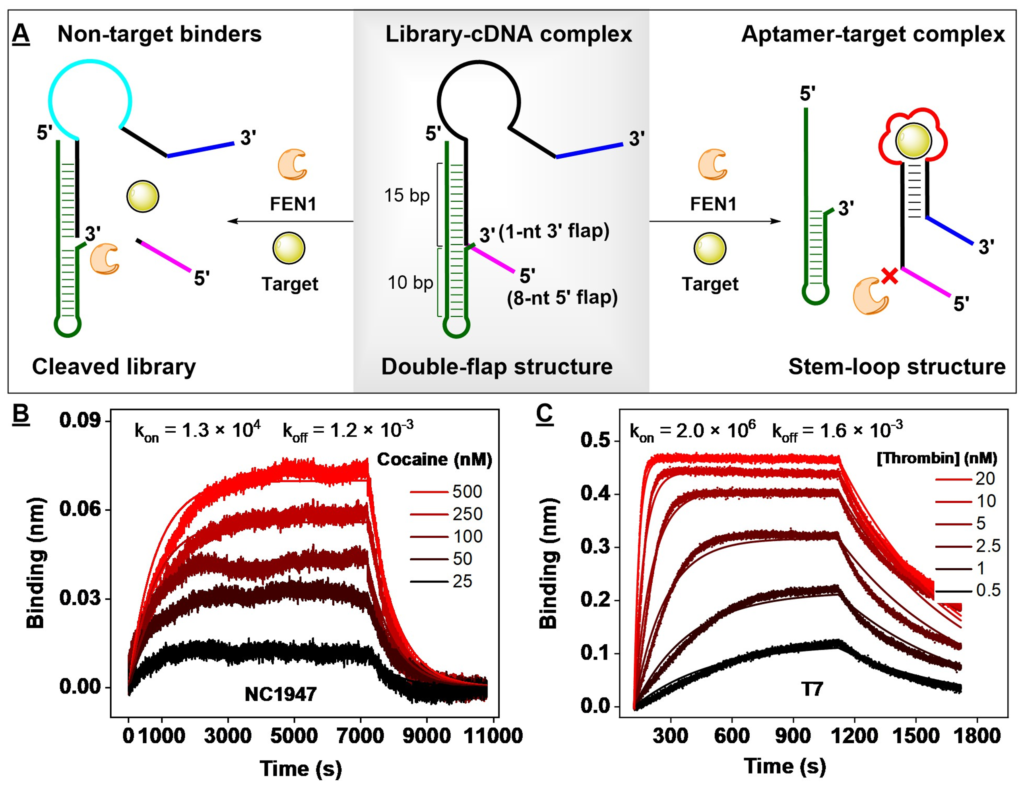
Sci. Adv. 2024, 10, eadl3426
High Throughput Sequencing Analysis
We use and develop bioinformatic tools for aptamer candidate selection and motif analysis. These include traditional sequencing analysis software’s such as fastaptamer, cutadapt, and MEME-Suite for sequence abundance and enrichment analysis as well as new generative variational autoencoders and deep learning transformer models for motif extraction and binding affinity predictions.
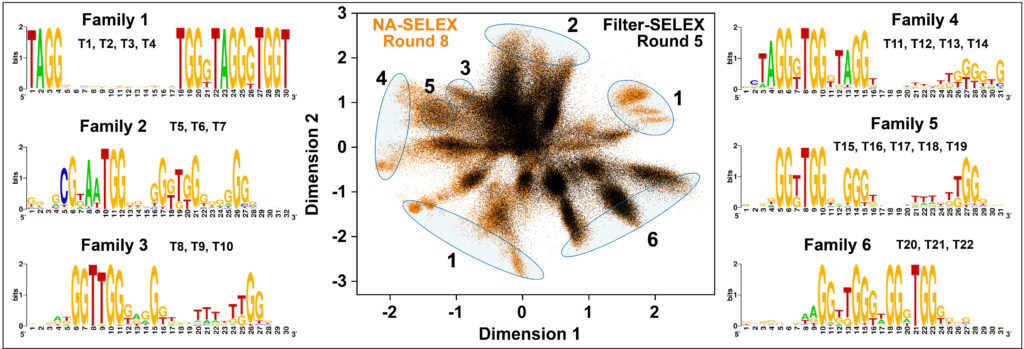
Sci. Adv. 2024, 10, eadl3426
Characterization & Engineering
We characterize the binding properties of aptamers using a variety of different gold-standard biophysical methods, such as isothermal titration calorimetry, biolayer interferometry, microscale thermophoresis, and circular dichroism. We also develop new methods to characterize aptamers, such as the exonuclease digestion assay, which enables the high-throughput screening of aptamer binding properties. We perform sequence engineering to adopt a variety of useful functionalities into aptamers, such as structure-switching functionality and cooperative ligand binding, that are ultimately used to enable applications such as molecular sensing and therapy.

J. Am. Chem. Soc., 2026, 148, 10421 – 10436
Sensor Development
We develop aptamer-based biosensors for a variety of analytes of biomedical, forensic, and environmental interest. Our detection platforms include electrochemical, colorimetric, and fluorescent sensors, all of which share common attributes such as ease and simplicity of use, single-step detection, rapidity, as well as high selectivity and sensitivity.
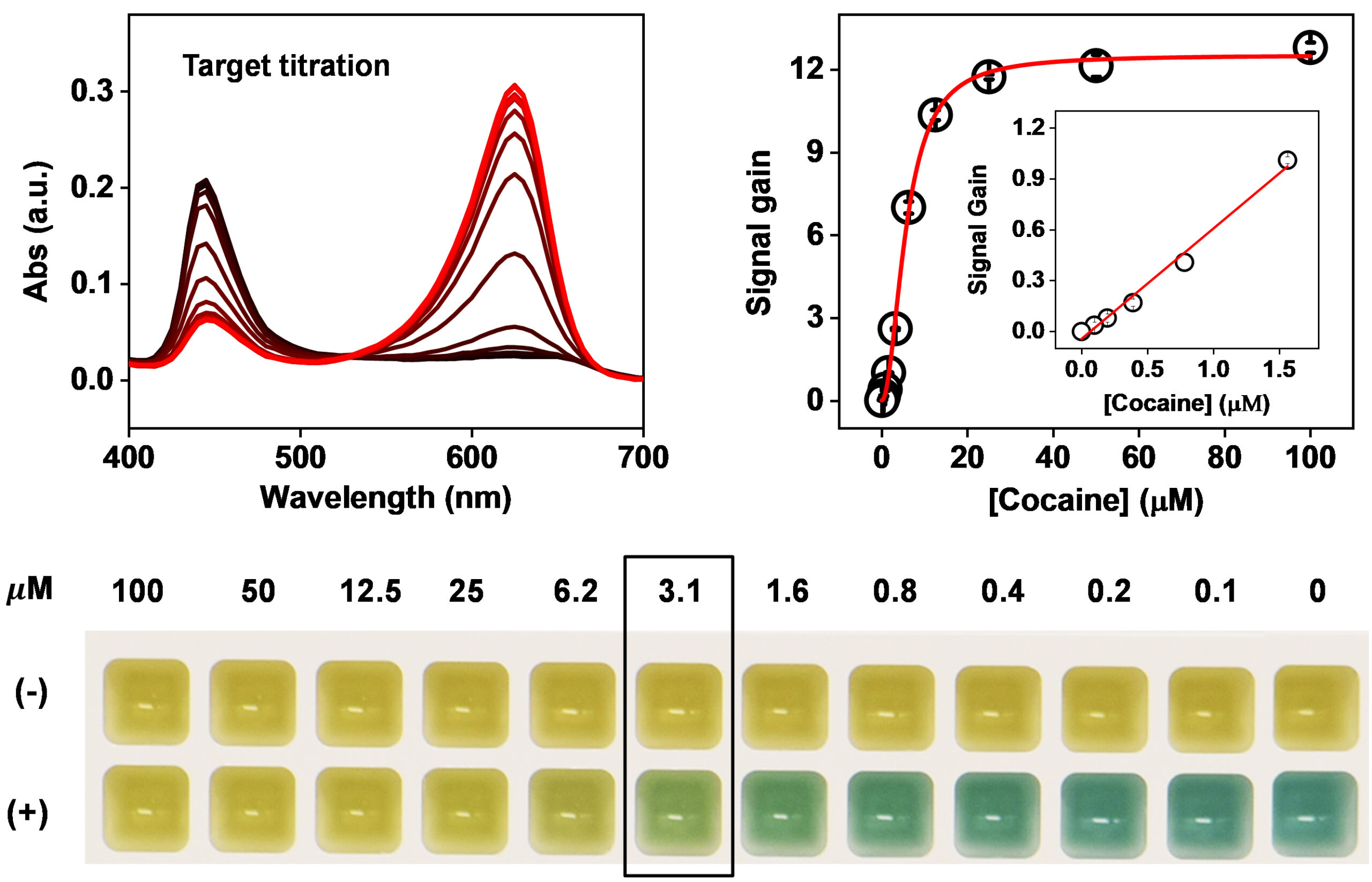
ACS Sens., 2025, 10, 7799 – 7809